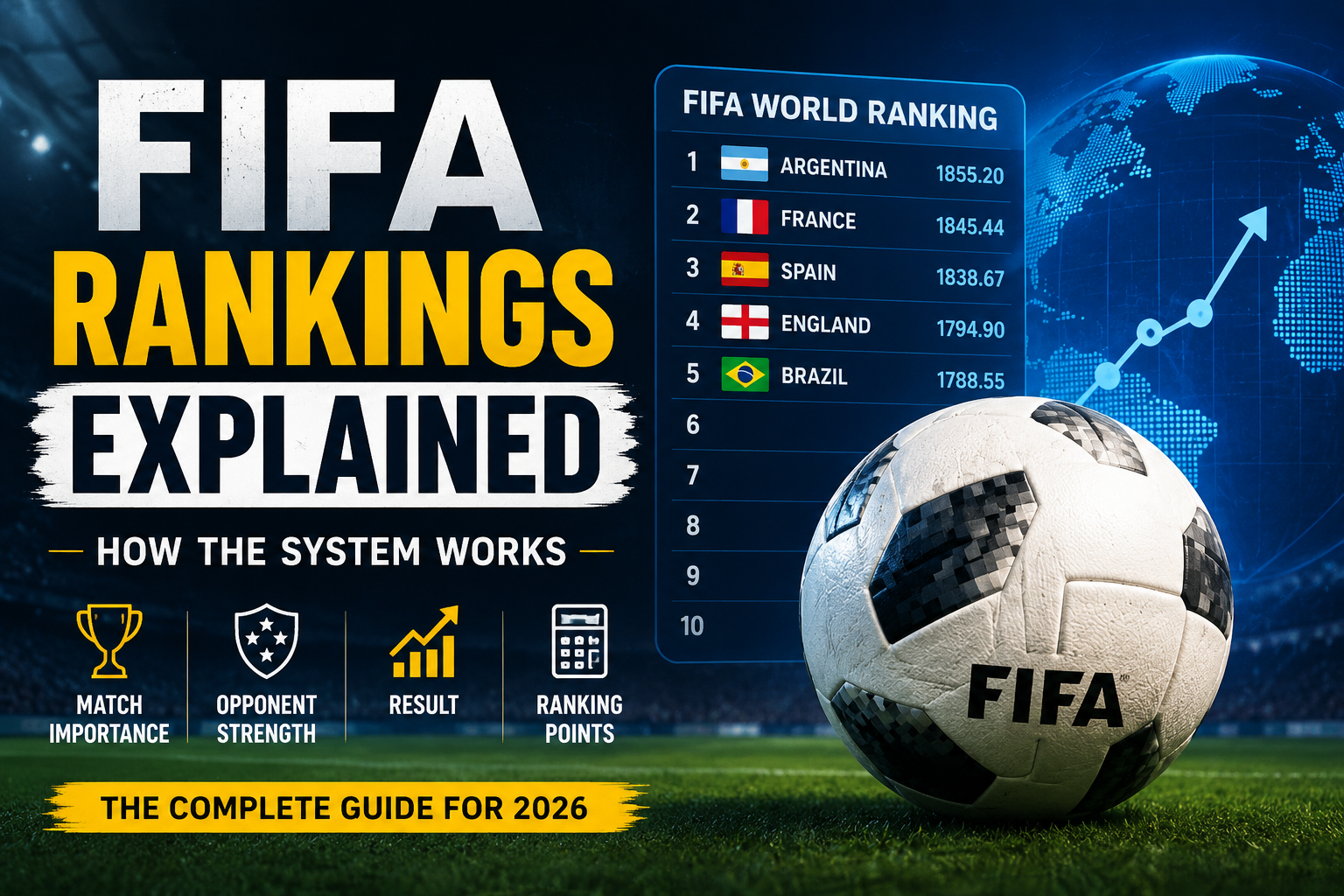
FIFA Rankings Explained: How the System Works
Football is the world’s most popular sport, and every national team dreams of becoming the best. But how does FIFA decide which country deserves the No. 1 spot? Why do some teams move up the rankings after a single match while others barely change? The answer lies in the FIFA World Ranking system.
The FIFA Rankings are an official ranking system used by FIFA to measure the performance of men’s and women’s national football teams. These rankings influence tournament seedings, international reputation, and sometimes even qualification pathways for major competitions such as the FIFA World Cup.
Many football fans see the rankings change every month without understanding the calculations behind them. In reality, FIFA uses a sophisticated mathematical formula that rewards strong performances and takes into account the importance of each match.
This guide explains everything you need to know about FIFA rankings in simple language. Whether you’re a casual football fan, a fantasy football player, or someone preparing for the FIFA World Cup 2026, you’ll learn exactly how the system works.
Table of Contents
- What Are FIFA Rankings?
- Why FIFA Rankings Matter
- History of FIFA Rankings
- How FIFA Calculates Rankings
- The “SUM” Ranking Formula Explained
- Match Importance and Weighting
- Which Matches Earn the Most Points?
- Why Teams Gain or Lose Ranking Points
- Example of a Ranking Calculation
- Men’s vs Women’s FIFA Rankings
- Advantages of the Ranking System
- Criticisms of FIFA Rankings
- Frequently Asked Questions
- Final Thoughts
What Are FIFA Rankings?
FIFA Rankings are an official list of national football teams arranged according to their recent performances in international matches.
Instead of relying on opinions or popularity, FIFA calculates rankings using data from actual matches. Every official international game has the potential to change a team’s ranking.
The rankings are updated regularly and include more than 200 national teams from around the world.
The current ranking system rewards:
- Winning matches
- Defeating stronger opponents
- Performing well in important tournaments
- Maintaining consistent results over time
Unlike club football rankings, FIFA rankings only apply to national teams.
Why FIFA Rankings Matter
Many fans assume FIFA rankings are only for bragging rights, but they have significant practical value.
1. World Cup Seeding
One of the biggest uses of FIFA rankings is determining seeding for international tournaments. Higher-ranked teams are more likely to avoid facing other top teams in the early stages of competitions.
Better seeding can create a more favorable path through a tournament.
2. International Reputation
A higher FIFA ranking signals that a national team has been performing consistently well against quality opposition. This boosts the team’s global reputation and often increases media attention.
3. Tournament Draws
Regional competitions and FIFA tournaments frequently use the rankings to organize groups fairly.
4. Team Development
National football associations use rankings as a benchmark to evaluate coaching, player development, and long-term progress.
History of FIFA Rankings
FIFA introduced the Men’s World Ranking in December 1992 to create an objective way of comparing national teams.
Initially, the system relied on a relatively simple points method. Over time, experts criticized it because it sometimes rewarded teams for playing fewer matches or allowed teams to manipulate their rankings.
To improve fairness, FIFA introduced several updates.
The most significant change came in August 2018, when FIFA adopted the “SUM” ranking system. Instead of averaging points over time, the new approach updates a team’s rating after every international match, making the rankings more responsive and accurate.
The Women’s FIFA World Ranking follows a different calculation method, but its goal remains the same: to measure national team performance fairly.
How FIFA Calculates Rankings
The modern FIFA ranking system is based on a mathematical rating model similar to the Elo rating system used in chess.
Instead of assigning fixed points for wins, FIFA adjusts a team’s total based on four main factors:
- Match result
- Match importance
- Opponent strength
- Expected outcome before kickoff
If a team performs better than expected, it gains more points.
If a team loses to a much weaker opponent, it loses a significant number of points.
This creates a dynamic ranking system that reflects current performance rather than historical reputation.

The FIFA “SUM” Formula Explained
The current formula is straightforward in principle:
New Rating = Previous Rating + Match Importance × (Actual Result − Expected Result)
Here’s what each part means:
Previous Rating
The number of ranking points a team had before the match.
Match Importance
Different competitions carry different weights. A FIFA World Cup match has far greater impact than a friendly.
Actual Result
This reflects what happened in the match:
- Win = 1
- Draw = 0.5
- Loss = 0
Expected Result
FIFA estimates the likely outcome based on the ranking difference between the two teams before the match. If an underdog wins against a much stronger opponent, it earns a larger increase because the result exceeded expectations.
This system rewards surprise victories while limiting gains from expected wins against weaker teams.
Why Strong Opponents Matter
Not all wins are equal.
For example:
- Defeating the world’s No. 3 team provides a much bigger ranking boost than beating a team ranked No. 170.
- Losing narrowly to a top-ranked team generally has less negative impact than losing to a much lower-ranked side.
- Consistent performances against quality opposition are one of the fastest ways to climb the FIFA rankings.
This approach encourages teams to schedule competitive fixtures rather than relying only on weaker opponents.